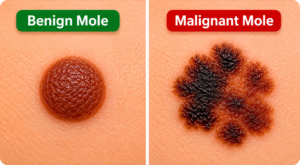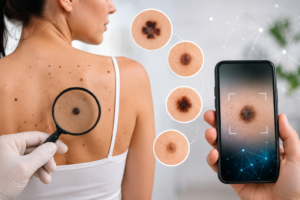
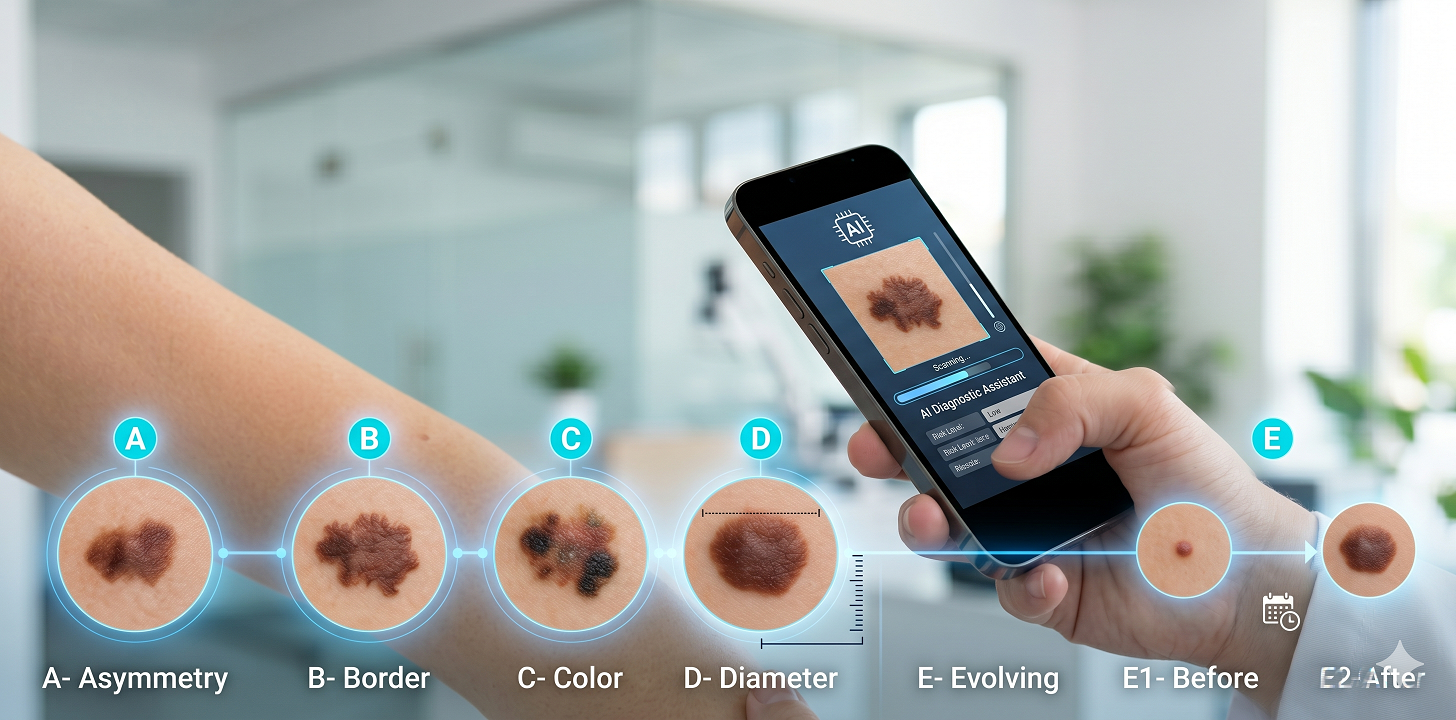
The ABCDE checklist is a way to look at a mole or spot for five visual cues: asymmetry, border, color, diameter, and evolving. It is a public self-check, not a diagnosis. If even one letter applies — or the spot is changing — book a clinician rather than waiting for a longer list of signs.
What A, B, C, D and E mean
The American Academy of Dermatology describes the letters as follows, in everyday language:
A is for asymmetry. One half of the spot does not match the other half.
B is for border. The edge is irregular, scalloped, or poorly defined instead of a smooth outline.
C is for color. Color is uneven from one area to the next — for example shades of tan, brown or black, or patches of white, red, or blue.
D is for diameter. Many melanomas are larger than 6 millimeters (about the size of a pencil eraser) when they are diagnosed. The AAD is explicit that melanoma can still be smaller than 6 mm. A small spot is not automatically safe.
E is for evolving. The spot looks different from the rest of your moles, or it is changing in size, shape, or color. Itching or bleeding is also a reason to get it checked.
Halves do not match
Irregular or poorly defined
More than one shade
Often >6 mm; can be smaller
Changing, or unlike the rest
Limits of the checklist
This is a memory aid, not a test. Some melanomas do not look like the classic pattern. You do not need several letters at once. One concerning feature — especially change — is enough to stop self-monitoring and get an in-person exam.
The wording above follows the AAD page What to look for: ABCDEs of melanoma. That page also advises seeing a board-certified dermatologist for new spots, spots that look different from others, or spots that are changing, itching, or bleeding.
What to do next
If a letter applies, treat it as an action item: schedule a clinician visit. When should you worry about a mole? walks through urgency versus slower change.
A photo screening tool can add a structured look at a single image. SkinToScan does that on the health analysis tool page. It returns screening insights from a photo. It is not a diagnosis, not a biopsy, and not a reason to skip a dermatologist if the mole itself worries you.